Valparaíso
My Tender MatadorValparaíso is both a passageway and a charged backdrop: a port city the Queen and Carlos cross in secret on their way to Laguna Verde, and the site of a public humiliation that haunts Augusto Pinochet. Its monumental Parliament building embodies the political future he fears, while the city’s ravines and evening lights frame the Queen and Carlos’s last conversation before their paths separate.
A City on Two Routes
The narrative brings two journeys into Valparaíso at nearly the same time. A small presidential motorcade climbs Cerro Castillo as Pinochet and his wife look toward the new Parliament building. Elsewhere, the Queen and Carlos take a taxi toward the port, bound for Laguna Verde. Their routes converge in the city’s geography but not in experience: the presidential party moves under security and public scrutiny, while the Queen and Carlos try to avoid notice. The taxi’s progress is slow and indirect because the road is blocked; Carlos directs the driver to go up and around, and the Queen obeys his repeated gestures to keep quiet.
From the taxi, the Queen sees the Parliament building at a red light and calls it an ugly construction, like a hospital for politics. Carlos tries not to laugh and signals that she should remain silent. The passing encounter gives the building an intimate, irreverent counterpoint to the importance Pinochet assigns it. For him it is a monument; to her, it is an absurdity glimpsed from a taxi while she and Carlos evade the attention surrounding the president.
Parliament and Political Insecurity
The new Parliament building rises above the ravines and shantytowns of the port in a display of modern architecture. Pinochet takes pride in it, alongside the Carretera Austral, and imagines that such colossal works will secure his place in posterity. Yet the building also brings him face to face with the possibility that an election could remove him from power. He fears that political opponents might win and occupy the very structure he regards as a legacy. His wife’s suggestion that the building could become a five-star hotel sharpens the irony: she treats its future as a practical question, while he measures it against the possibility of losing office.
The fear is partly undercut by a constitutional provision that Pinochet knows his wife does not mention: the new constitution designates him a senator for life. That assurance briefly eases his anxiety as the towers appear against the sky. The building’s political meaning, however, is not under his control. When he previously visited the construction site, workers shouted insults from above. Mistaking their cries at first for acclaim, he answered with a salute; once he understood them, he shouted back at the workers. Cameras recorded the confrontation, and it was broadcast throughout the country. The security detail failed to find the protesters amid the vast construction site. For Pinochet, the Parliament is thus at once a personal monument, a reminder of political vulnerability, and the setting of a televised loss of composure.
Ravines and the Road to Laguna Verde
The taxi route carries the Queen and Carlos through downtown and then along garbage-filled ravines behind the port. The Queen finds the landscape sinister, comparing it to Wuthering Heights, but the road eventually opens onto Laguna Verde. From the hill, the beach appears secluded: a small village of four houses is the only visible sign of human settlement on that stretch of coast. The shift from the city’s constricted, refuse-strewn slopes to the open shore makes Valparaíso a threshold between exposure and temporary privacy.
At the beach, the taxi driver agrees to return at five o’clock. The Queen and Carlos leave their bags and run toward the water, sharing a brief, playful closeness after the tense journey. Their time there does not resolve the dangers or differences that brought them together, but it gives the Queen a moment of release before their return. The taxi will take them back through the port city, and the beach’s brief refuge remains bounded by the journey that brought them there.
Evening Lights and Farewell
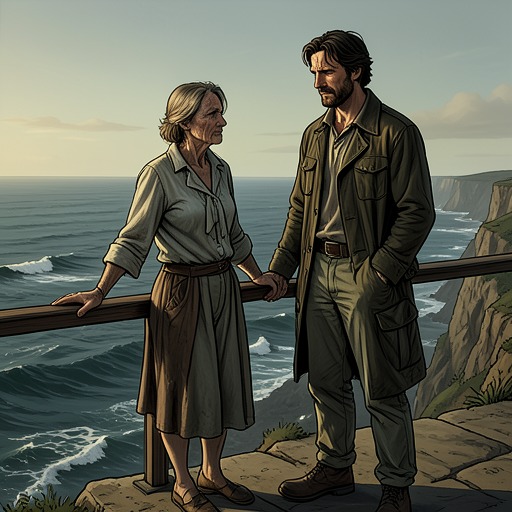
Later, as darkness settles, the Queen looks across the water toward Valparaíso, whose lights crown the hills. She recasts the distant city as a festive island and then as a decorated boat, turning its urban outline into images of celebration and departure. Carlos, by contrast, keeps his eyes lowered and mechanically brushes sand from his feet. His silence marks a change in their familiar exchange: the Queen continues her poetic descriptions, but he no longer joins in as he once did.
Carlos asks the Queen to come with him to Cuba. The invitation makes the separation explicit: he says he is leaving the next day and can still obtain a ticket, while explaining that those who took part in the action are leaving the country. The Queen hears the offer as something close to a marriage proposal, but recognizes that it cannot give her the love she longs for. She says that their lives belong to stories that scarcely touched, and that what did not happen between them in Chile will not happen elsewhere. As she accepts the limits of the invitation, Valparaíso’s lights continue to furnish her images of celebration, but the city’s glow cannot turn the farewell into a shared future.
The taxi horn breaks their silence, and they gather their bags for the return trip. The Queen lies when Carlos asks whether she has collected everything. Behind them, the tide advances over the white tablecloth left on the beach. The city remains visible as a field of lights while the two leave the shore, its geography holding together the contrast at the heart of the passage: a landscape imagined as beautiful and festive, and a relationship whose hoped-for continuation is refused.